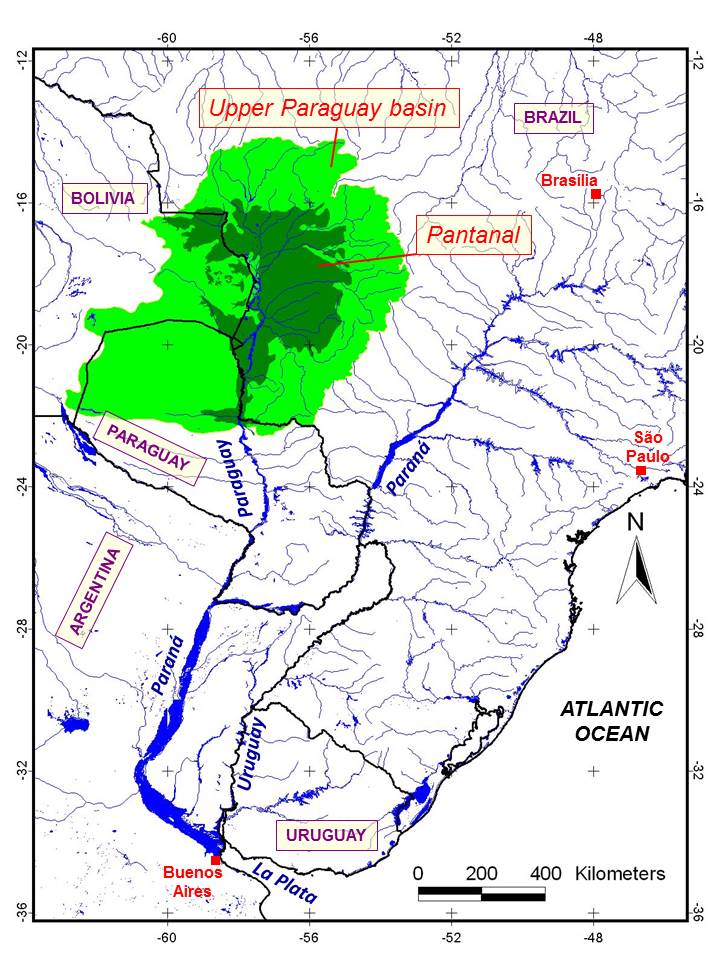
The Pantanal of central-western Brazil , eastern Bolivia , and northeastern Paraguay is a huge (210,000 km2, i.e., areas of Belgium , Netherlands , Switzerland , and Portugal combined) alluvial plain that drains the headwaters and tributaries of the Upper Paraguay River.
It encompasses a complex mixture of tropical forest, savanna, and aquatic environments adapted to a highly variable annual flood that may last as long as six months and cover as much as 110,000 km2.
The Pantanal provides important ecosystem services for the region, including sequestration of CO2 by forests, regulation of the rainfall regime and river flows, purification of water by wetlands, and delivery of nutrients and sediments to flood plains.
It supports a highly productive and diverse assemblage of neotropical flora and fauna, including high-density populations of a variety of freshwater fishes and migratory wading birds, as well as hyacinth macaws, capybaras, caiman, tapir, white-lipped peccaries, and jaguar. The Pantanal was designated by UNESCO as a Biosphere Reserve and is considered one of the most well-preserved biomes in South America.
Conservation Challenges
Because more than 95% of the Brazilian portion (70% of total Pantanal) and the highlands that surround the region consist of private properties, the Pantanal has been vulnerable to recent economic trends that have driven large-scale deforestation and agricultural development. On the highland plateaus that drain into the Pantanal, nearly 60% of the cerrado forests have been cleared and converted to cash crops (e.g., soy, corn, and cotton) or exotic (non-native) pasturelands during the last 50 years.
These cerrado forest formations (i.e., savanna forests typical of seasonal plateau regions) comprised the second largest forest biome in Brazil (after the Amazon), but are currently threatened, since 55% of their original 2,000,000 km2 have been converted to agriculture during the last 35 years. The decline in regional CO2 sequestration because of cleared forests and the release of CO2 from decaying trees are serious long- and short-term consequences of deforestation, both in the highlands and on the flood plain. Exacerbating increased CO2 releases in the region is the current demand by the Brazilian steel industry for charcoal fuel, which is produced from downed trees near deforestation sites. As demand has increased from the steel industry, charcoal producers have lowered the costs of deforestation, stimulating additional habitat destruction by short-sighted ranch owners.
Conservation Approach
To track progress during implementation of the RMP, project consultants monitor financial, socioeconomic, and environmental indicators established for each ranch. WCS’s work in the Pantanal is the first to empirically and scientifically document and demonstrate the consequences of poor and best ranch management practices on a wide variety of environmental and socioeconomic indicators, including peccaries, bats, amphibians, and freshwater ecosystems.
Great expectation and excellent institutional / policy influence has been achieved, including partnerships with key governmental agencies, universities, and local NGOs, such as EMBRAPA-Pantanal, Universidade Federal de Mato Grosso do Sul (UFMS)m and Mato Grosso (UFMT), IAGRO (IAGRO (State Institute of Animal Health), UNIDERP and UCDB (local private state Universities), Estancia Ambiental Quinta do Sol, among others.
Goals
To prevent further deforestation and the array of related consequences in the Brazilian Pantanal and highlands, we work with landowners to promote sustainable ranch management practices that are profitable alternatives to deforestation and habitat conversion.
Using a team of consultants and researchers, we evaluate each partner ranch and develop a management plan to optimize profitability and reduce pressures on natural resources. By adopting best-management practices that remove economic incentives for deforestation and concentrate cattle impacts within a limited area, the ranch management plan (RMP) is able to reduce pressures on natural resources while increasing ranch profitability and efficiency.
Activities
In 2006, two partnerships with landowners in the southeastern Aquidauana/Rio Negro region of the Pantanal were established, encompassing approximately 6,000 ha of well-preserved forests, wetlands, and native savannas.
On one of the ranches, we set up an experimental pasture rotation system that has been the focus of a number of studies examining the sustainability of the technique in terms of native pasture condition, cattle productivity, ranch profitability, and impacts on forest and wetland communities. These studies represent the first experimental investigations of pasture rotation in the Pantanal.
Results to date show that there are significant advantages to using a rotation system in comparison to traditional open-range grazing, such as increased biomass and quality of native pasture, increased cattle weights, improved reproductive success of cattle, and decreased impacts on forest understory and wetland plant communities. Additional studies comparing forest and wetland communities between areas with different levels of cattle use have shown that in areas of high cattle impact, species composition is altered and diversity is reduced. The rotation system minimizes these impacts by improving native pasture conditions and, as a consequence, reducing cattle foraging in forests and wetlands.
From 2007 through 2008, the project expanded as a result of the dissemination program, which included a WCS-Brasil - sponsored landowner workshop, several visits by potential partners to the experimental rotation area, two WCS-Brasil - sponsored courses for landowners and ranch workers demonstrating best-management and artificial insemination techniques, and attendance by the project coordinator and researchers at meetings for cattle producers and scientific congresses. In the Aquidauana/Rio Negro region, where the original partnerships were established, three new ranches, totaling 9,500 ha joined the project. In addition, formation of partnerships in three new regions of the Pantanal basin and two regions in the highlands are in progress, which would add another 37,500 ha.
The total area protected by established and new partnerships is now approximately 53,000 ha. By recruiting partners in different regions of the flood plain and in the highlands, we hope to expand the impact of the project as local pockets of neighboring ranchers begin to recognize the benefits in terms of profitability and reduced environmental impact. Some of the neighboring ranchers are potential future partners, while others may adopt improved ranching practices independently.
Threats
Increasing the economic viability of ranches through a variety of environmentally-sound, sustainable, ranch-management techniques will eliminate economic justifications for deforestation and habitat conversions in the Pantanal. The forests that are preserved as a result of the project will benefit the entire region through maintenance of ecosystem services, such as CO2 sequestration and regulation of water balance.
Reduced pressures on natural resources (e.g., less foraging by cattle in forest understory and wetlands as a result of improved native pasture and grazing conditions), will also benefit forests and aquatic habitats. Landowners will benefit directly from improved economic viability of ranches through increased profits and long-term economic sustainability, and ranch employees will benefit from improvements in housing and income made possible by increased profits. Another benefit of the project for ranch owners and workers includes educational outreach provided by project leaders and consultants. The program provides basic knowledge concerning best-management practices, training for specific techniques, such as artificial insemination, and advice for implementing conservation measures.